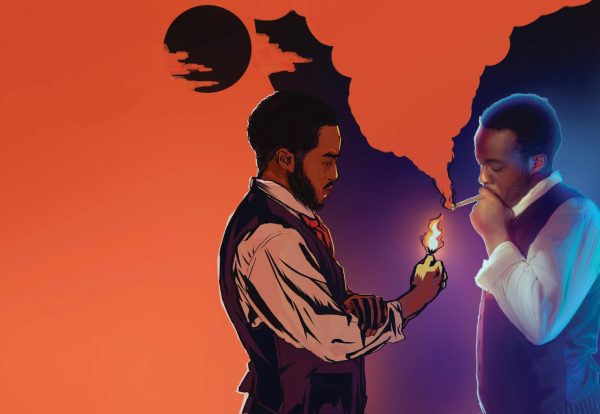
In April 2025, Ryan Coogler released his fifth feature film, “Sinners.” Starring Michael B. Jordan, the film focuses on twin brothers, Smoke and Stack, and the opening of their new juke joint in the Mississippi Delta. Accompanying them is their cousin Sammie “preacher boy” Moore, played by Miles Caton. However, their plans are interrupted by Remmick, an Irish vampire, who is lured by Sammie’s musical abilities.
The film also stars Hailee Steinfeld, Wunmi Mosaku, Delroy Lindo, Jayme Lawson, Omar Benson Miller, and Li Jun Li.

One of the many beauties of this film is its messages. The film discussed race, religion, the effects of colonization and oppression, the importance of culture, and other nuanced themes. It also gives the viewer a chance to rewatch the film and pick up on things they might not have thought about when first watching the film.
The Music
The film starts with a folktale: “There are legends of people born with the gift of making music so true, it can pierce the veil between life and death, conjuring spirits from the past and the future. In ancient Ireland, they were called Filí. In Choctaw land, they called them Firekeepers. In West Africa, they’re called Griots. This gift can bring healing to their communities… but it also attracts evil.”
These words, although at first random, lay the foundation of the rest of the film.
The soundtrack–composed by Oscar-winning composer Ludwig Goransson–uses different genres to create the elements of the score and soundtrack. The music is an artistic amalgamation of different genres and styles.

The soundtrack includes blues and bluegrass (“Travlin,” “Pick Poor Robin Clean”), rap (“Sinners,” “Flames of Fortune”), folk/traditional (“This Little Light of Mine,” “Will ye go, Lassie, go?”) and rock (“In Moonlight,” “Last Time I Seen the Sun”). One of the film’s most striking songs is “I Lied to You,” performed by Miles Caton.
This ethereal sequence showcases Black people’s influence in music and the progression of Black music and dance through time. For example, there is a guitar player–resembling funk guitarists of the 1970s– who appears and plays with Sammie, demonstrating the progression of rock music.
The genre was born in the 1950s, with musicians like Sister Rosetta Tharpe and Chuck Berry. “Hound Dog,” commonly considered by many to be the first rock song, was actually written by Big Mama Thornton, not Elvis Presley.
Religion
During the entire film, Sammie is at a crossroads with his identity. He’s known as “preacher boy,” often speaking and singing for his father’s congregation. He even prays for safety when at the hands of Remmick. On the other hand, he often goes against his father’s words.
During their scenes together, his father begs him to reject the lifestyle of “sin.” Before Sammie’s performance, Delta Slim tells him, “Blues wasn’t forced on us like that religion. Nah, son, we brought this with us from home. It’s magic, what we do. It’s sacred, and big.”

One of the biggest elements in Black culture–and by association, Black cinema– is Christianity. Characters use faith in order to get out of tough situations, or it’s used as a tool to separate from good and evil. However, there are not many Black films that talk about the struggles of being Black and Christian.
Some–like Delta Slim–see Christianity as an aspect of colonization and do not feel connected to the Eurocentric interpretation of it. There are many who have been told that how they live or identify does not belong in the church and, therefore, should be shunned.
Some have had outright traumatic experiences tied to religion. But those viewpoints are either demoralized or are completely unshared. To have Sammie, a young Black man, being conflicted on the two major aspects of his life, is not only a way to move the story forward, but is also a major piece of representation.
Cultural appropriation/Identity
Beneath the characters of Sammie, Smoke, and Stack, there is a different aspect that is often overlooked, despite it being the centerpiece of the film: identity. Most, if not every, character is related to identity in some way.

According to the video essayist “The Closer Look,” a good way to see culture’s influence in the film is to separate the characters into two groups: those who have accepted or assimilated and those who have not.
Mary, Stack’s lover, feels like an outcast due to her mixed heritage. Her ties to both worlds are nonexistent when we first meet her in the film. Her mother passed away, she is stuck with a man who does not understand her, and Stack is distant towards her.
Another example is with Remmick, who was forced to assimilate into English culture during the colonization of Ireland.
Throughout the film, he resists his initial cultural heritage. In fact, he only uses his heritage when trying to hypnotize someone into becoming a vampire. For example, Remmick uses the folk song “Will Ye Go, Lassie, Go?” In order to lure Mary into accepting her fate. He also sings “Rocky Road to Dublin,” which is a siren call to Sammie.
A lot can be said about “Sinners,” and there is only so much one can write in an article. But I personally think the discussion about “Sinners” will never die down. There are very few films that have been analyzed for years, if not decades, after they’ve been published. “Sinners” will certainly be a part of that list.